INTRODUCTION
There has been extensive
research conducted for the United States and Great Britain into the so–called “family
gap” in pay, that is the differential in wages between women with children and
women without children (Robert Wright (1988), Christine Greenhalgh (1980),
Francine Blau and Lawrence Kahn (1987, 1996, 2000), Jane Waldfogel (1995, 1998,
1999), Abraham Katharine (1987), James Smith and Michael Ward (1989), Susan
Harkness (1996), Michal Mick and Gillian Paul (2004)). However, there is little
Canadian analysis on family gaps for women. Since 1990, Quebec and Ontario have
followed different policy paths regarding parental leave. The purpose of this
paper is to exploit the variations in policy across these two provinces and
over time to investigate the effect of parental leave on the family gap. I will
show how these differences in policy affect the family gap in these provinces. The
question I want to answer is this: does maternity leave contribute to women with
children earning higher wages?
Several
conditions have made maternity provision protection more important for policy
makers in the recent years, notably the dramatic changes in the labour market
in the past several decades, including women’s increasing participation rate in
the labour force and the falling fertility rates related to work–family time
pressure and the growing commitment to eliminate discrimination in employment.
This new importance of maternity leave is reflected in the fact that at least some
maternity leave provision exist in the legislation of most of the developed
countries.
This paper is
organized as follows: After the Introduction,
a Literature Review containing ten
different papers on the topic of reasons, size and magnitude of family gap is
incorporated. In the next part I discuss the Theoretical Framework of the hypothesis I want to test, and then
talk about the recent Policy Changes
concerning maternity benefits, with special attention paid to the two provinces
Quebec and Ontario. The next section describes the Empirical Strategy. The Database
Description section is followed by the Estimated
Results and finally the Conclusion
is presented.
LITERATURE REVIEW
Francine D. Blau
and Lawrence M. Kahn (2000) in their paper paid special attention to the issue
of discrimination when talking about gender differences in occupation. They
compare the maternity leave benefits of the United States to the other OECD
countries and find that the maternity and family leave available for the
mothers of these countries is different in the sense that the rest of the OECD
countries have a much longer period of leave. The figures show that a longer
maternity leave has a positive effect on women’s pay after they are going back
to work.
Waldfogel (1998)
finds that while the gender gap narrowed during the 1980s and 1990s in the
United States and Great Britain, the gap between women with children and those
without children has been widening. Her tests and results tell us that the
effect of maternity leave it is significant when looking at the family gap in
pay. According to her findings, the US lags in the area of family policies such
as maternity leave and childcare. In fact, it is the only one among those
countries included[1]
in her study, which does not offer any kind of paid leave. In the United
Kingdom there is also little public provision for women with children.
Canada’s
position was already more generous in 1994 than the US and UK in the provision
of benefits, according to Waldfogel (1999). She showed that mothers here were
better off in terms of after–leave wages than their counterparts in the U.S.
and the United Kingdom. She attributes this to the relatively more generous maternity
leave laws in place in Canada. Waldfogel suggests that the gap between mothers
and other women may be smaller in those countries with an extensive family
policy framework. She mentions that in Scandinavian countries, like Sweden and
Denmark, there is only a small negative effect of children on women's pay.
Waldfogel (1998)
calls the difference between the wages of women with and without children a
family penalty. She cites other researchers, like Fuchs (1988), and Korenman
and Neumark (1992) who found that this family penalty is about 10–15 percent
even after characteristics such as education and work experience has been
controlled for. It should be mentioned that married men receive a family
premium ranging from 10–15 percent according to Jacobsen and Rayack (1996) and
Korenman and Neumark (1991). Waldfogel’s findings, that there is a wage premium
associated with job protection say that this way the negative effect on income
of having children can be offset.
Waldfogel (1998)
argues that maternity leave coverage raises women’s pay in the way that more
women might return to their former employer after childbirth and by this
mothers' subsequent wages become higher. According to her research, this might
be suggestive that providing better coverage could close about 40 percent of
the family gap due to penalties associated with having children.
Waldfogel (1998)
controls for heterogeneity bias, by employing two separate methods. The first
method is a first difference specification, where the individual effect is
assumed to be time invariant and is potentially correlated with one or more of
the independent variables. Uses early (mean 21) and late (mean 30) wage
observations. If the unobserved characteristics vary across individuals but not
over time, this method, according to Waldfogel, effectively removes it. The
second method is a fixed effect specification, and as above, this specification
relies on the assumption that the fixed effects are time invariant. "The
fixed effect model uses three reported wages from three different years to
track the effects of children on wages over time. Taken together, the first
difference and fixed effects models provide no evidence of significant
heterogeneity bias. Controlling for unobserved heterogeneity has had little
effect on the estimated wage effects of children."
Other
researchers have looked at the question of family gap in pay as well. For
example, Phipps, Burton and Lethbridge (2001) examine why Canadian women with
children have lower wages than those women without. They use the 1995
Statistics Canada General Social Survey (GSS) data to examine the importance of
the time spent out of the labour market for mothers. In order to achieve their
goal Phipps, Burton and Lethbridge control for time spent out of labour force
since they are suspicious of total time out being endogenous to income: women
with higher income take less time out caring for children while women with
lower wages are more likely to take longer time out of the labour market. Phipps,
Burton and Lethbridge take account of the direct as well as the indirect impact
of total duration of time out. The direct impact is that individuals do not
acquire additional experience while taking time out, and also their human
capital might deteriorate during the time out, while the indirect impact is no
gaining seigniority and therefore possible movement from the primary to the secondary
labour market. They conclude that having ever had a child is strongly
significant. This result supports the importance of job protected maternity
leave.
Todd and
Sullivan (2002) studied the effects of children on households' disposable
income, although they did not look specifically at women’s wages. They found
that the fiscal effect of children is smaller in Norway, Finland, and the
United States than in Australia, Canada, Germany, Sweden and the United
Kingdom.
Waldfogel and
Harkness (1999) extend Waldfogel's earlier analysis of the family gap to
include data from five other industrialized countries in addition to the United
States and the United Kingdom: Australia, Canada, Germany, Finland and Sweden.
They mostly used databases from 1994 and 1995 for the seven sample countries,
and looked at the population between 24 and 44 years of age. They find that
when looking only at full time workers the wages of women without children
exceeded the wages of women with children in each and every sample country.
Moreover, they find that children reduce women's employment much more in Australia,
Germany and the United Kingdom than in Canada and the United States. Because of
this variation across countries Waldfogel and Harkness (1999) ask whether
policy differences might cause these distinctions. Waldfogel and Harkness
suggest that this topic be evaluated further with special attention paid to the
role maternity leave and child care have in closing the pay gap between mothers
and other women.
Finally,
Anderson, Binder and Krause (2002) address the issue of how different women pay
the wage penalty of motherhood in the United States. Their results reveal a difference
in this family gap among non–Hispanic white women and black women. Since
mothering also effects education and occupation, they also conduct different
regressions for educated and non educated women. Their findings show that for
white women, the least educated mothers bear no penalty at all, while college
educated mothers of two or more children have the highest wage–disadvantage. As
they control for unobserved heterogeneity, they find that exiting the labour
force explains a smaller percentage in the case of black women than white women
(12 and 20 percent respectively). Anderson, Binder and Krause suggest that this
puzzle cannot be explained by human capital variables, and therefore needs
further research.
THEORETICAL
FRAMEWORK
This section
presents the motivation for the hypothesis I would like to test. The paper’s
aim is to investigate the impact of maternity benefit policies on the wages of
women with children. Particularly, the goal is to determine the influence of
maternity benefits on the family gap in Canada.
My hypothesis is
that family gap decreases with maternity leave coverage. And this is manifested
in the higher wages of mothers after taking time off for raising children. Although
a woman who has child related work interruptions does not acquire experience
during the time out, with maternity coverage available more women might return
to their former employer after childbirth and by this their subsequent wages
are higher.
Maternity leave
coverage may "induce women who would otherwise have left the labour market
altogether for a lengthy period of time to instead return by the end of the
leave period and to maintain employment continuously with their employer".
(Waldfogel, 1998) By this, maternity leave can provide a safety net for women
over the period of childbirth, therefore raise their level of work experience
and job tenure, thus can redeem the family gap in pay.
POLICY
CHANGES
Effective
Maternity leave
is designed to give expectant mothers the possibility of withdrawing from work
in the later stages of their pregnancy and to allow them some time to
recuperate after childbirth. Parental leave is available for both parents while
they are caring for their new born child. Benefits usually cover 55% of a
claimant’s weekly insurable earnings, to a maximum of $413 per week. There are
nonetheless exceptions: claimants who are in a low–income family with a net annual
income of less than $25,921 and who are receiving the Child Tax Benefit can
receive a higher benefit rate called family supplement. (http://www.sdc.gc.ca/asp/gateway.asp?hr=en/ei/types/)
To be eligible,
an employee must have worked a minimum of 600 hours in the previous 52 weeks or
since the start of her last claim. Every Canadian jurisdiction requires
employers to reinstate employees who have taken a maternity leave to their
former position or to a comparable one with equivalent wages and benefits. This leave can usually be supplemented by
adding a period of parental leave. The federal government (the
Employment Insurance program) provides maternity and parental benefits, while
the provincial labour standard laws are responsible for the provision of job
protection.
In Quebec, since January 1, 1991 each mother and father was entitled to a
maternity leave combined with parental leave not exceeding 34 consecutive
weeks. The additional leave was funded by the province and was paid at the same
rate as the EI benefits.
The extension of
parental leave is a very significant development in the Canadian employment
standards legislation. In 2000, encouraged by the lead of Quebec, all the
remaining Canadian jurisdictions increased parental benefits from 10 weeks to 35
weeks, while keeping the previously available 15 weeks of maternity benefits.
This way, starting from December 31, 2000 everyone had their labour legislation
in accord with the Employment Insurance parental benefits.
The only exception was Quebec, where the legislative power decided to
come up with an individual program for the mothers from their province. While the federal government
increased the period of paid leave from 25 weeks to 50 weeks, and Ontario
responded to this by increasing its job protection from 25 to 50 weeks, Quebec
left its job protection at 34 weeks.
EMPIRICAL STRATEGY/MODEL
I start with
Ordinary Least–Squares regression on a broad range of data to see whether
different circumstances provide different results, and gradually narrow it
towards a specific interest group.
This group then serves as a baseline for further investigation. Afterwards I
use several techniques and methods to control for possible heterogeneity,
sample selection bias and endogeneity. These methods include Quasi Cohort
analysis and Heckman Two–Step Selection Correction Estimation.
The dependent
variable in each model is lnW – the
natural logarithm of hourly wage for all paid–worker full time jobs during the
reference year.
In forming the
baseline model I will use a combination of Waldfogel's (1998) and Viitanen’s
(2004) family gap model. These models share many features with the following
equation regarding their explanatory variable selection:
lnW = α + β1 E + β2 C + β3 U + β4 P + β5 F + β6 O + β7 Y + β8 I + β9 A + β10 S + β11 N + ε
(1)
E = highest
level of education (grouped in 7 categories); C = Size of Area of
Residence (grouped in 5 categories); U = member of a union or covered
by a collective agreement; P = indicator of whether the employer is
in the public or private sector; F = firm size, based on the number
of employees at all locations in Canada; O = seven groups for
Standard Occupation Classification code; Y = Number of years of work
experience, which includes all part–time and full–time work since first starting
to work full time– a value of zero is given for people with less than a year of
experience and for those who have never worked full–time; I = total
other income calculated based on the sum of family income less a woman's own
income; A = person's age as of December 31 of the reference year;
S = age squared; N = number of children in the family.
I keep all
individuals who were employed full–time at least partially during the reference
year and I drop agriculture workers (approximately 1.5% of the total
population) in order to avoid the seasonal variability of the collected data in
their case.
Quebec and
Ontario, the two most populous provinces of Canada, are good candidates for
comparison. They have similar economic and geographic environments, they are
influenced by the same business cycles, and there is homogenous data collection.
Although there are some undeniable social and cultural differences between
Quebec and Ontario, I suggest that comparing these two is still more plausible
than the comparison of family gaps between two different countries like the
United States and France, for example. If we assume that the relative cultural
differences remain static over this period (1999-2003) than these differences
in culture between Ontario and Quebec will be differenced out by the double
difference estimator. As well, we assume that the distribution of children's
ages in the period 1999–2003 is constant. In other words the number of newborns
in each year is similar, and therefore the number of women eligible for
maternity leave is similar each year as well. Together, these assumptions
insure that DID estimates are consistent.
The self
selection problem I am concerned with is that women with children who return to
work are not randomly selected from women with children. Sample selection
problem might be greater for mothers, because of the arising child care costs. Since
mothers and other women may differ in some additional characteristics as well, the model needs to
include a productivity
factor that can
account for the
self–selection problem. When a mother decides whether to go back to work after
a leave of absence child–care costs can be very decisive. Low–productivity workers, who would not earn enough to cover childcare
costs, might stay at home. Therefore, only the high productivity women would
get a job and earn income.
Waldfogel (1997)
says that one possible answer to the main question of why women with maternity
leave coverage have higher wages is that they are more productive than their counterparts
are. Maternity leave coverage and wages might be positively correlated in her
study (on the United States) because coverage is more likely to be part of the
compensation package of highly productive workers. The maternity leave I am
studying is statutory, and covers all workers who meet the basic eligibility in
terms of hours worked. This endogeneity issue is therefore less likely to cause
any problems in my study, than in research that looks at the effect of
maternity leave provisions in private contractual agreements.
In order to show
the distinct policy effects in the two provinces I pool the data from year 1999
with data from 2000 and from years 2002 with 2003. This way, the model could
better represent the wage effect in the respective periods given that there was
a policy change at the end of year 2000. The distinct policy effects may be
reflected in women's wages of 2002 – 2003.
To follow the
main stream of research and to obtain results which are comparable to the
existing literature I run a set of OLS regressions for each year between 1999
and 2003 on a sub–sample of the SLID database. I estimate regression equations
on a
sub–sample of women aged 25 – 34 year who are employed full–time for at
least some period during the survey year and who have positive non-zero hourly
wages.
To control for
observed heterogeneity the log of composite hourly wages is regressed on a set
of human capital and demographic characteristics including educational
background, city size, unionization, employed at a public or private firm, firm
size, occupation, work experience, other income (other family members' income
less a woman’s own), age, and age squared.
By Age Group
As a first step
I separate the 25 – 34 year age group into 25 – 29 and 30 – 34 five year
groups. By doing this, unobserved heterogeneity among women can be reduced
since women within a five year age band are also more likely to have similar
social characteristics and responsibilities than women in the larger age group
25 – 34. For example, women aged 25 – 29 and who have children are likely to
have similar responsibilities with respect to their children’s care, since
women in this age group likely have children of a similar age. This may not be
true for women aged 30 – 34 and who have children since women from this group
may have children of greatly differing ages. Children of these mothers may
require vastly different care and so the effect of children on these women may
not be comparable. Therefore, it is most appropriate to only consider mothers
aged 25 – 29.
Province–by–Year Effect
In the second
step needed to arrive to the core dataset of this analysis is to separate the
two provinces of Quebec and Ontario from the rest of the country and each other
for the 25 – 29 age group mentioned above. Concentrating on these two provinces
only is justified in two ways. First, 49% of the observations come from Ontario
and Quebec which suggests that we cannot expect significantly different results
for Quebec and Ontario than for the rest of the country. Second, as the OLS and
other regression results show later, the coefficients of child effects on wages
were the same for Ontario than those for the whole country when excluding
Ontario and Quebec.
Quasi Cohort Analysis
The Quasi Cohort
Analysis allows us to run a regression on a group of women aged 25 – 29 in the
period of 1999 – 2000 and another regression on the group aged 30 –34, in 2002
– 2003. The data for the quasi cohort is formed by pooling data from the years
1999 – 2000 and 2002 – 2003, respectively, for each province separately. The
underlying assumption of this method is that the relationship for those aged 25
– 29 in 1999 – 2000 will remain constant over the time period being considered.
For each
province the coefficients from each cohort are compared. The aim here is to
determine whether the cross cohort difference in the family gap is different
for Quebec and Ontario. Each of these estimates is consistent and therefore the
differences between them are also consistent.
The way things
evolved (described in the policy changes section) between Quebec and Ontario
provides natural environment for a retrospective quasi–experimental cohort
analysis. In such a study, one would identify two cohorts with similar
characteristics and the values of state variables of interest in steady state
within those cohorts. These variables also serve as explanatory ones from which
to draw conclusions. One cohort (Ontario) receives one or a sequence of policy
interventions on its economic environment while the other gets no intervention.
Eventually one compares the occurrence of the outcome.
Heckman Two–Step Selection Bias Control
A typical cause
for concern when estimating wage equations for females is that there may be a
sample selection issue to the extent that many of the women in the sample are
not engaged in paid work and therefore have no wages. This question might be
further complicated if we deal with women with children and without children
since the decision to have children gives raise to potential endogeneity of
fertility status with respect to wages. Therefore we might need to deal with three
types of selection bias.
To separate
these issues first we have to decide whether to keep those in the sample who
have zero wages. First, if we decide to keep them in our sample then we face
the problem of Sample Selection Bias. Sample Selection Bias refers to a problem
when the dependent variable is available only for part of the respondents. When
a substantial fraction of women are not engaged in paid work because their
returns to participation would be relatively low, simply running a regression
with wage as the dependent variable and the number of children as one of the
explanatory variables, without further treatment of the sample, may lead to
biased estimates of the effect of children on wages.
In the second
version we might decide not to keep those women who do not have non–zero
(positive) composite hourly wages in our sample. Then the dependent variable is
available for all observations but an independent variable included in the
model which is having a child is potentially a choice variable. Running a
regression on wages as a dependent variable and the dummy indicating that a
woman has one or more children may still lead to biased estimates of the effect
of children on wages. The reason for this potential bias is the fact that women
with children may differ from those women without children in many observable and
unobservable characteristics. This is sometimes called heterogeneity or
endogeneity bias.
Finally the
third possible version of our problem is the joint selection bias meaning that
the database contains both the above mentioned shortcomings. Using the SLID
database to estimate the effect of children on women’s wages we are confronted
with both types of biases in the same model. In a model of this type, the
participation in the labour force and the endogeneity of fertility are not
interpreted as independent and therefore have to be estimated simultaneously.
Analysing the
second type of selection bias, namely heterogeneity bias and the third, joint
selection bias, is not a purpose of present project but the effect of potential
SSB is of special interest. In handling this problem I use Heckman Two–Stage
Selection Bias Control to account for participation in the labour force. The
wage equation to be estimated is
lnWi = Xiβ
+ γ
To account for
labour force participation the Heckman two step model is using the probit model
for individual i
Pi
= Ziδ
+ ε
With the
decision to enter the workforce given by P = 1 if Pi > 0 and 0 otherwise, where P is a variable
for propensity to participate in the labour force and Z is a vector of personal
household and economic characteristics affecting the woman decision to enter
the labour force and u are normal disturbances.
One important
condition for the use of Heckman Two–Step model is that in order to make the
probit model work the database used should contain both those observations
where the independent variable is equal zero and non–zero.
A second
condition is that the probit model contains at least one variable which is not
related to the dependent variable in the wage equation. The most successful probit
equation contained the joint use of the following variables: years of work
experience, number of children, total other family income, age of youngest
child, city size, and the number of adults in the family. The variable of total
other family income was excluded from the wage equation model to act as an
excluded instrument in the probit model.
The number of
adults in the family may have a positive effect on the probability of a mother
working since adults may share in performing household tasks, allowing a mother
more time and energy to devote to work. It could be the case that having more
adults in the family could have an effect on wage due to peace of mind and less
stress but this seems like a secondary effect and would therefore not affect
wages greatly.
The age of the
youngest child may be relevant factor in explaining a mother’s probability of
working since having a young child will require more parental attention. As
above this seems to have a marginal secondary effect on women's wages.
The total of
other family income seems important in determining a mother’s decision to work
since families with higher income are more likely to afford child care,
allowing the mother more freedom to pursue her career.
It will be
argued that these variables are not related to a mother’s wage. For example, the
number of adults in a mother’s family does not logically seem to be a factor in
determining her wage, nor is it information that an employer can or would
request.
The age of the
youngest child is not something that is likely to directly affect a mother’s
wage, since it is not information that employers can or would request. In
addition, total other family income seems to be something that is outside the
factors that affect a mother’s wage. For these reasons, these three variables,
the number of adults in the family, the age of the youngest child and the total
other family income are suitable excluded instruments in the Heckman Two–Step
Selection Bias Control.
DATABASE DESCRIPTION
This analysis
uses the Survey of Labour and Income Dynamics (SLID). This is a longitudinal
survey, meaning that data are collected from the same person for several years,
with primary focus on labour and income variables and the relationship between
them and family composition. For this
analysis, I have to resort to the use of the publicly available database that
was published each year between 1999 and 2003 containing a sum of 363,479
observations. This is a cross sectional sub–sample of the confidential
longitudinal Database public–use microdata file and includes a collection of
income, labour and family variables on persons and families in Canada.
Both the
confidential and the publicly available database contain very detailed
classification of income sources. Wages and salaries are gross earnings from
all jobs held by a person before deductions. It includes composite hourly wages
available for all paid workers during the reference year. This is calculated
based on the implicit hourly wages, weighted using total hours paid for each.
With reference to labour data, the data set includes information about a
person’s work experience, jobless periods, and job characteristics for the
survey year. In terms of education, SLID has data both about educational
activity and educational attainment. Although, the number of children per
households is not provided, it is possible to calculate it by merging the
economic family, census family and personal data files using the provided key file.
I included all
women who were employees but excluded those who were not participating in the
labour force. Self–employed women are also not included in the model since
their reported income might be different from those of employees and they are
not covered under the Employment Insurance Act. Only women who are married or
in a common–law relationship are included. These considerations aim to reduce
unobserved heterogeneity among the survey families used.
There are some
shortcomings of my data from the perspective of my identification strategy. For
example, the exact ages of children is not observed. In order to avoid the
problems arising from this lack of information, I narrowed down the sample to
women between ages 25 to 29. This can help in assuring that their children are
somewhat in the similar age group.
Table 1
presented below contains selected Summary Statistics from the Survey of Labour
and Income Dynamics SLID database published each year between 1999 and 2003,
used in the models of this paper. It is worth mentioning that between the two periods
the relative change in the hourly wages in the provinces of Quebec and Ontario
was 18.18% and 9.6% respectively.
Table 1 Selected Summary
Statistics from the Survey of Labour and Income Dynamics SLID database
published each year between 1999 and 2003, used in the models of this paper.
|
|
Quebec |
Ontario |
||
|
|
1999–2000 |
2002–2003 |
1999–2000 |
2002–2003 |
|
Number of observations |
828 |
833 |
1 373 |
1286 |
|
|
Mean |
Mean |
Mean |
Mean |
|
Composite hourly wage |
12.92 |
15.27 |
14.16 |
15.53 |
|
Total Other Income |
21
870 |
24
733 |
23
817 |
24
288 |
|
Education |
|
|
|
|
|
0 – attended high school |
14.0% |
9.6% |
6.8% |
6.9% |
|
Graduated from high school |
9.8 |
5.1 |
11.9 |
11.2 |
|
Non–University (no certificate) |
10.6 |
11.9 |
10.9 |
8.9 |
|
Some University (no certificate) |
1.6 |
1.6 |
4.5 |
5.8 |
|
Non–University certificate |
37.2 |
41.4 |
34.4 |
38.1 |
|
Bachelor's degree |
20.9 |
23.9 |
23.3 |
22.1 |
|
Above BA/MA/PhD |
6.5 |
6.6 |
8.2 |
6.5 |
|
Number of Children |
|
|
|
|
|
None |
52.4% |
55.9% |
62.8% |
63.4% |
|
One |
23.6 |
23.2 |
17.1 |
19.4 |
|
Two |
17.4 |
14.4 |
14.6 |
13.7 |
|
Three or more |
6.6 |
6.5 |
5.5 |
3.5 |
|
Marital Status |
|
|
|
|
|
Married |
25.2% |
18.5% |
48.2% |
42.4% |
|
Common law |
39.4 |
39.6 |
10.3 |
9.6 |
|
Separated |
4.0 |
4.2 |
3.4 |
3.7 |
|
Divorced |
0.7 |
1.6 |
1.2 |
0.8 |
|
Widowed |
0.1 |
0.1 |
0.1 |
0.3 |
|
Single (never married) |
30.7 |
35.9 |
36.7 |
43.2 |
|
Firm Size |
|
|
|
|
|
Less than 20 |
35.4% |
21.3% |
24.1% |
21.0% |
|
20 to 99 |
20.0 |
14.9 |
17.0 |
16.0 |
|
100 to 499 |
10.3 |
12.7 |
13.9 |
10.3 |
|
500 to 999 |
7.9 |
6.6 |
8.4 |
4.8 |
|
1000 and over |
26.3 |
21.9 |
36.7 |
47.9 |
|
Class of worker |
|
|
|
|
|
Employee |
91.9% |
94.1% |
95.5% |
94.3% |
|
Some business |
8.0 |
5.9 |
4.5 |
5.7 |
|
Union membership |
|
|
|
|
|
Yes |
28.7% |
30.1% |
24.9% |
24.8% |
|
Only collective agreement |
2.7 |
2.8 |
1.5 |
1.1 |
|
Neither |
68.5 |
67.1 |
73.6 |
74.1 |
|
Job type |
|
|
|
|
|
Full–time |
80.6% |
79.9% |
86.3% |
78.9% |
|
Part–time |
19.4 |
20.1 |
13.7 |
21.1 |
|
Public/private sector |
|
|
|
|
|
Public sector |
19.2% |
25.2% |
22.4% |
21.4% |
|
Private sector |
80.8 |
74.8 |
77.6 |
78.6 |
RESULTS
The estimated
family gaps based on the OLS regressions for Ontario and Quebec for each of the
years 1999 to 2003 and for full time employed women aged 25 – 34 are shown in
Figure 1. The coefficients for one, two, and three or more children presented
come from the basic regression model discussed earlier in the Theoretical
Framework section (detailed results available upon request). The results show
that the effect of children on women’s wages is becoming smaller over the
sample period 1999 – 2003.
Table 2 The family gap in
Ontario in 1999–2000
|
|
The family gap in Ontario in 1999 – 2000 |
|
|
|
OLS |
Heckman Two–Step |
|
One Child |
–0.055 |
–0.045 |
|
|
(0.036) |
(0.032) |
|
Two Children |
–0.062** |
–0.044 |
|
|
(0.032) |
(0.036) |
|
Three or More Children |
–0.268*** |
–0.265*** |
|
|
(0.086) |
(0.069) |
The coefficients
of column one, Table 2 present the magnitude of the family gap for mothers of
one, two or three or more children from Ontario 1999 – 2000. In the second
column one can see that the coefficients obtained after controlling for
selection bias still represent a family gap of comparable magnitude.
By Age Group
The results of dividing
the 25 – 34 age group into two equal five–year sub–groups for Quebec and Ontario
group are presented in Figure 3 and 4. While the 25 – 29 age group’s
results show an unambiguous improvement for mothers' pay compared to
non–mothers (Figure 3) the 30 – 34 age group, for the Quebec and Ontario group,
shows some negative effect for those women with three or more children (Figure 4),
but the coefficients themselves are not significant (detailed results available
upon request).
Province–by–year Effect
Up to this point
we can discover some similarities in changes across the Quebec/Ontario group
shown in Figures 1 through 4 even through the various approaches applied. Since
population in these two provinces account for more than 49% of the total
population of the whole country, this number assures that focusing only on
Quebec and Ontario gives a good indication of the effect of policy changes
under investigation. Separating these two provinces holds the first surprise.
Focusing only on the data from Quebec I find that for women aged 25 – 29 in the
1999 – 2000 pooled data there is a child premium. Focusing only on Ontario and using the 1999 –
2000 pooled data presented in column 3 of Table A1 shows a child penalty for
each mother regardless of the number of children.
Quebec decided
not to follow the Canada–wide year–2000 policy changes and the 2002 – 2003
pooled years’ coefficients in column 2 Table A1 show that the premium for
having one child from 1999 – 2000 becomes a penalty, from a positive number
changed to a negative number, while there is a significant decrease in the
child premium for having two children, and the penalty for three or more
children becomes even greater. Since some of the women in my 'treatment group'
would actually have given birth under the old policy, at least those who have
two or more children, this might explain the above results.
For Ontario, the
results presented in Table A1 for the 2002
– 2003 pooled data show that the child penalties in 1999 – 2000 for one child
and three or more (26.8%) become a premium and the penalty for two children
(6.2%) become smaller. I also find that Canadian results excluding only Quebec
were similar to those of Ontario.
Table 3 Basic OLS results: Province
Difference; Time Difference; Difference–in–Difference
|
|
Que _ Ont |
Que _ Ont |
Que _ Que |
Ont _ Ont |
Diff–in–Diff |
|
One
Child |
0.110** |
–0.064 |
–0.065* |
0.109** |
0.174*** |
|
Two
Children |
0.125** |
0.031 |
–0.046 |
0.048 |
0.094 |
|
Three
or more children |
0.228** |
–0.173 |
–0.060 |
0.341*** |
0.401** |
Note: *** indicates
statistically significant at p < 0.01
** indicates statistically
significant at p < 0.05
* indicates statistically
significant at p < 0.10
Column 1 of Table
3 shows the differences between the coefficients for women having one two and
three or more children in Quebec in 99/00 minus those coefficients of Ontario in
99/00. These results emphasize that in the period of 99/00 Quebec had a
significant family premium compared to Ontario.
Column 4 of Table
3 shows the differences between the coefficients for women having one two and
three or more children in Ontario in 02/03 minus those coefficients of Ontario
in 99/00. The results indicate that over time the family gap became narrower or
even disappeared after the 2000 policy change. The numbers show a 10.8%
difference for women having one child and a 34% difference for mothers of three
or more children.
Finally, since
Quebec and Ontario are neighbouring provinces within a country we can use a
difference in difference strategy to identify the effect of the 2000 policy
change in Ontario. These results are displayed in column 5 of Table 3. They are
the magnitude of the change for Ontario compared to those similar changes in Quebec
indicating that the family gap decreased by 17.2% for mothers of one child and by
40% for those women having three or more children as a result of the policy
change in Ontario.
Quasi Cohort Analysis
The quasi–cohort
analysis results shown in Figure 9 for Quebec and Figure 10 for Ontario reinforce the previous findings of the OLS regression
using the pooled years 1999 – 2000 and 2002 – 2003 using women with children
aged 25 – 29. For Quebec, the implied effect of having children changes from a
premium for the first group (25 – 29 in 1999 – 2000) to a child penalty for the
second group (28 – 32 in 2002 – 2003) for women having two and three or more children
and with a slight improvement for those women having one child. The
corresponding numbers for Ontario show that for women with one or two children,
a child penalty for the first group becomes a child premium for the second
group while for women with three or more children a large child penalty for the
first group becomes a smaller penalty. These results represent the same general,
positive changes as those of the results using Ontario and Quebec using the
pooled years
1999 – 2000 and 2002 – 2003 and the age group 25 – 29.
Table 4 Quasi Cohort: Province
Difference; Time Difference; Difference–in–Difference
|
|
Que _ Ont |
Que _ Ont |
Que _ Que |
Ont _ Ont |
Diff–in–Diff |
|
One
Child |
0.110** |
–0.003 |
–0.036 |
0.077 |
0.113 |
|
Two
Children |
0.125** |
–0.065 |
–0.085 |
0.105* |
0.190** |
|
Three
or more children |
0.228** |
0.125 |
0.031 |
0.134** |
0.102 |
Note: *** indicates
statistically significant at p < 0.01
** indicates statistically
significant at p < 0.05
* indicates statistically
significant at p < 0.10
Column 1 of the
Quasi Cohort analysis displayed in Table 4 is identical to that of Table 3
since by definition a quasi cohort analysis is using the same data set for the
first period for both provinces.
On the other
hand, column 4 shows the differences between the coefficients for women of an
age group of 25 – 29 having one two and three or more children in Quebec in 99/00
minus those coefficients of Ontario in 99/00. Although these results have
different magnitude than those previously presented in Table 3 for the age
group of 25 – 29 (and seem to be somewhat moderate compared to them) the changes
point in the same direction. The coefficient for women having two children
indicates that over time their family gap became 10.5% narrower.
The difference–in–difference
method used to obtain column 5 presents a similar decrease in the family gap
for Ontario as the previous one in Table 3. This is not surprising though, since the coefficients obtained in the quasi
cohort analysis did not alter substantially from those of the basic findings.
Heckman Two–Step Selection Bias Control
The results for
the Heckman Two Step Selection Control estimation presented in Appendix Table A2
are similar to the main results from OLS in Table A1. The initial child premium
in Quebec becomes a child penalty for women with one and three or more children
and those with two children suffer a reduction of their child premium. At the
same time we can find a similar upward trend for Ontario as with the previous
results using only OLS. These results are also presented in Figure 9 and Figure
10 in the Appendix.
In order to obtain
comparable results to those in Table 3 and Table 4 the Heckman selection bias
control coefficients are reorganized and presented using the same difference in
province, difference in time, and difference–in–difference methods. These
findings are presented in Table 5:
Table 5 Heckman Two–Step
Selection Bias Control:
Province Difference; Time Difference; Difference–in–Difference
|
|
Que _ Ont |
Que _ Ont |
Que _ Que |
Ont _ Ont |
Diff–in–Diff |
|
One
Child |
0.128*** |
–0.031 |
–0.096** |
0.064 |
0.159*** |
|
Two
Children |
0.089* |
–0.005 |
–0.018 |
0.066** |
0.083* |
|
Three
or more children |
0.279*** |
–0.066 |
–0.087 |
0.258*** |
0.345*** |
Note: *** indicates
statistically significant at p < 0.01
** indicates statistically
significant at p < 0.05
* indicates statistically
significant at p < 0.10
When compared to
Table 3 and 4, Table 5 brings no surprising results. Column 1 contains the
inter province differences and shows the same premium for mothers in Quebec in
1999 – 2000 compared to those in Ontario. The usual upward trend is present
again in column 4 – the time difference for Ontario between the first and
second period. Finally, column 5 gives almost identical results using the
difference–in–difference method as the basic OLS coefficients in column 5 of
Table 3.
Summarizing
Table 3, 4, and 5 we can conclude that the findings all point in the same
general direction: Quebec's initial family bonus from the first period compared
to Ontario gradually disappeared as Ontario advanced after applying the new maternity
leave policy in 2000. Quebec's apparent slip behind Ontario might be reversed
once again when their even–more generous legislation becomes effective in 2006.
Until then, the data from the remaining three years for 2004, 2005, and 2006 might
reinforce these findings and provide an interesting extension for further
research.
Side Issues
Analysing the
remainder of Table A1 an interesting finding is that women who work in the
public sector do approximately 12% better than their counterparts who work in
the private sector, after controlling for other relevant factors (12 % is the
average of the 4 estimates from Table A1). Also of note is that women who
work in larger firms (more than 1000 employees, 500 – 999 employees, and 100 – 499
employees), as indicated by the coefficients of the firm size dummy variables,
earn significantly more than those in small firms (less than 20 employees),
after controlling for other factors. Similarly, union membership has a positive
effect on women's wages, with these women earning on average 9.6% more than the
non–unionized workers.
CONCLUSION
The evidence of parental leave coverage available for women in Canada is
investigated in this paper. Using a difference in differences estimator I compared
the wages of mothers before and after the policy change in Ontario to changes
in a similar group of mothers in Quebec over the same time period. Generally
results show that more generous maternity leave mitigates the family gap.
Longer parental leave coverage appears to ensure higher wages for
mothers. Covered maternity leave can be used to undo the negative effects of motherhood
on women’s wages. These results suggest that policy makers who wish to reduce
the family gap could implement covered maternity leave to help mothers
accommodate their adaptation to their work load and care for their children.
The issue of heterogeneity bias and joint Heckman Sample Selection Bias
is not a central focus of this paper. Analysis which focuses on these issues
may lead to different results. However, I do control for Sample Selection Bias
which aims to correct part of the joint Heckman SSB.
The findings of this paper tell us that Quebec had a wage premium in
1999 – 2000, but after the policy changes initiated in 2000, Ontario’s women
with children earned more relative to women in Ontario with no children.
Figure 1 Family Gap in Wages: Quebec and Ontario
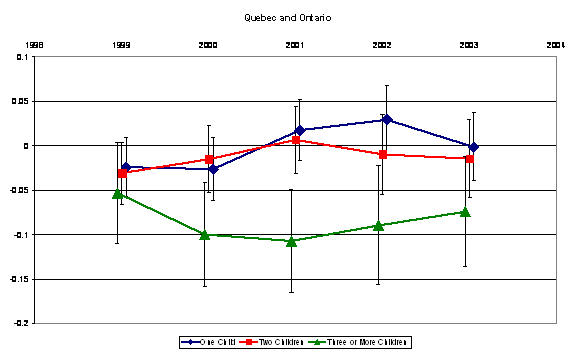
Figure 2 Age Structuring Effect: Age Groups: 25 – 29 Quebec and Ontario
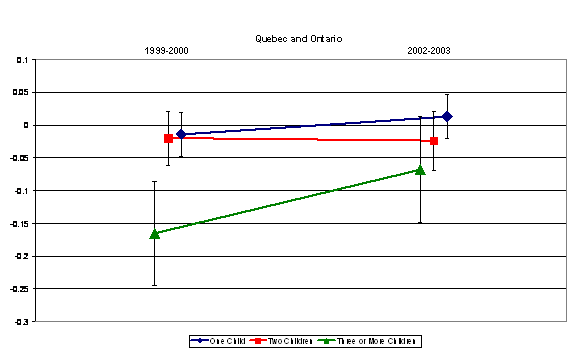
Figure 3 Age Structuring Effect: Age Groups: 30–34 Quebec and Ontario
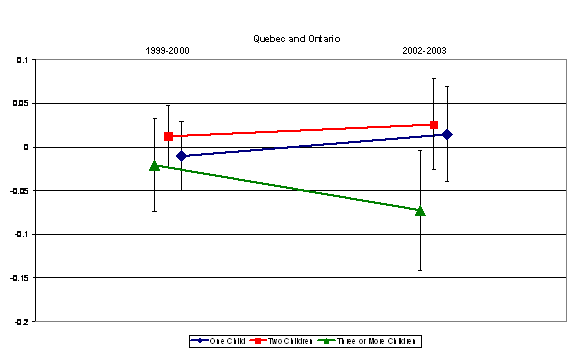
Figure 4 Province Selection Effect: Quebec
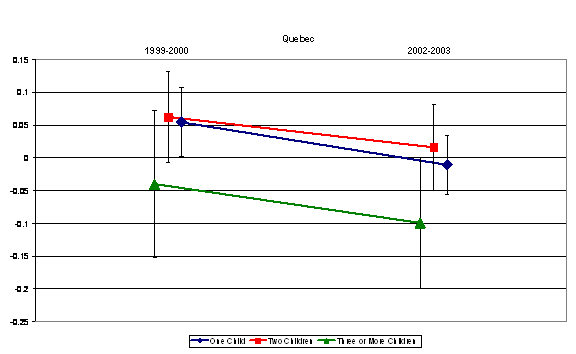
Figure 5 Province Selection Effect: Ontario
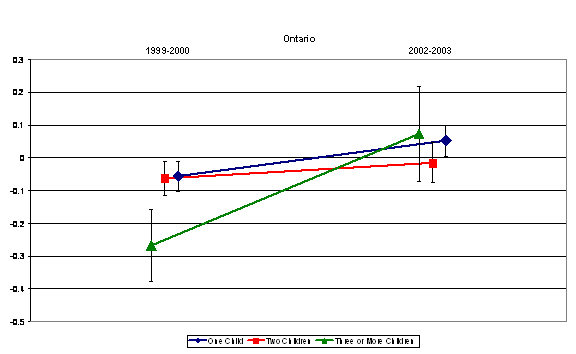
Figure 6 Quasi Cohort Analysis: Quebec
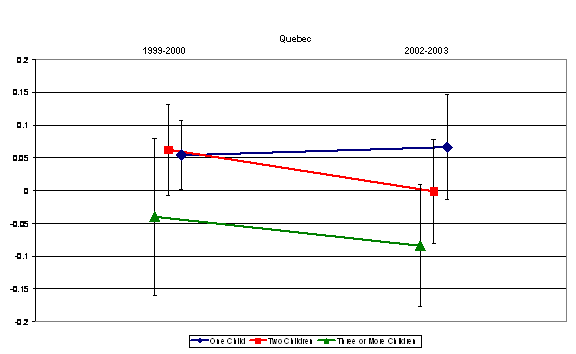
Figure 7 Quasi Cohort Analysis: Ontario
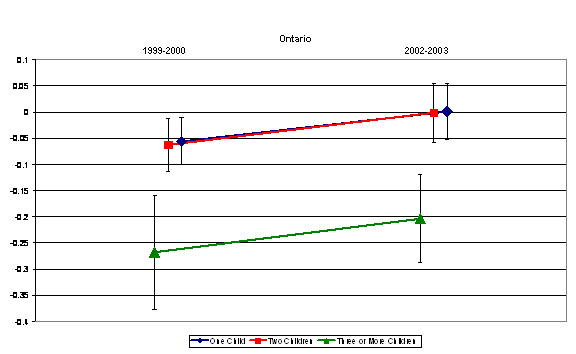
Figure 8 Heckman Two–Step Method: Sample Selection Bias Control Quebec

Figure 9 Heckman Two–Step Method: Sample Selection Bias Control Ontario
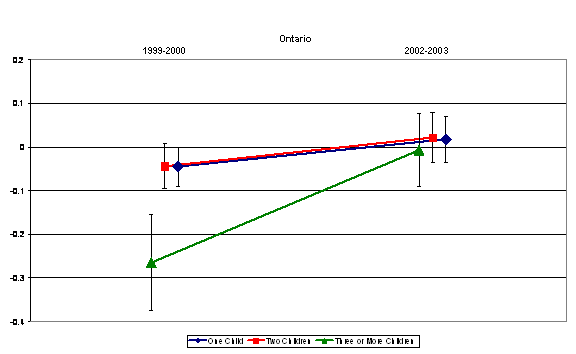
Table A1 Main results for
age group 25 – 29
|
|
Quebec |
Ontario |
||
|
|
1999–2000 |
2002–2003 |
1999–2000 |
2002–2003 |
|
One Child |
0.054* |
–0.011 |
–0.055 |
0.053 |
|
|
(0.031) |
(0.038) |
(0.036) |
(0.042) |
|
Two
Children |
0.062 |
0.016 |
–0.062** |
–0.015 |
|
|
(0.055) |
(0.051) |
(0.032) |
(0.053) |
|
Three or
More Children |
–0.039 |
–0.099 |
–0.268*** |
0.073 |
|
|
(0.086) |
(0.085) |
(0.086) |
(0.114) |
|
Education |
|
|
|
|
|
Graduated from high school |
0.007 |
–0.003 |
0.072 |
0.072 |
|
|
(0.069) |
(0.083) |
(0.062) |
(0.065) |
|
Non–University (no certificate) |
–0.010 |
0.032 |
0.049 |
0.153** |
|
|
(0.070) |
(0.066) |
(0.058) |
(0.070) |
|
Some University(no certificate) |
0.119 |
0.146 |
0.115* |
0.168** |
|
|
(0.177) |
(0.128) |
(0.070) |
(0.078) |
|
Non University certificate |
0.190*** |
0.070 |
0.146*** |
0.141*** |
|
|
(0.057) |
(0.058) |
(0.053) |
(0.058) |
|
Bachelor's degree |
0.295*** |
0.305*** |
0.261*** |
0.266*** |
|
|
(0.065) |
(0.062) |
(0.057) |
(0.061) |
|
Above BA/MA/PhD |
0.340*** |
0.270*** |
0.367*** |
0.256*** |
|
|
(0.089) |
(0.075) |
(0.065) |
(0.070) |
|
City Size |
|
|
|
|
|
5 000 – 29 000 |
–0.014 |
0.036** |
0.001 |
–0.019* |
|
|
(0.051) |
(0.043) |
(0.055) |
(0.067) |
|
30 000 – 99 000 |
0.032 |
0.006*** |
–0.037* |
–0.042*** |
|
|
(0.055) |
(0.053) |
(0.049) |
(0.067) |
|
100 000 – 500 000 |
–0.063 |
–0.027 |
–0.008 |
0.000*** |
|
|
(0.051) |
(0.046) |
(0.044) |
(0.056) |
|
More than 500 000 |
0.093*** |
0.032*** |
0.043*** |
0.024*** |
|
|
(0.041) |
(0.036) |
(0.044) |
(0.058) |
|
Union
Member |
0.090** |
0.054* |
0.130*** |
0.110*** |
|
|
(0.044) |
(0.036) |
(0.030) |
(0.034) |
|
Public
sector |
0.082* |
0.108*** |
0.097*** |
0.149*** |
|
|
(0.050) |
(0.038) |
(0.033) |
(0.035) |
|
Years of
Work Experience |
0.015*** |
–0.000 |
0.007* |
–0.000 |
|
|
(0.005) |
(0.000) |
(0.004) |
(0.000) |
|
AGE |
–0.119 |
–0.319 |
0.152 |
0.166 |
|
|
(0.468) |
(0.396) |
(0.344) |
(0.375) |
|
AGE
squared |
0.002 |
0.006 |
–0.002 |
–0.002 |
|
|
(0.008) |
(0.007) |
(0.006) |
(0.006) |
Table A1 (Continued)
|
|
Quebec |
Ontario |
||
|
|
1999–2000 |
2002–2003 |
1999–2000 |
2002–2003 |
|
Firm Size |
|
|
|
|
|
20 to 99 |
0.050 |
0.072 |
0.000 |
0.058 |
|
|
(0.040) |
(0.038) |
(0.033) |
(0.035) |
|
100 to 499 |
0.083* |
0.130 |
0.060* |
0.152 |
|
|
(0.053) |
(0.039) |
(0.036) |
(0.039) |
|
500 to 999 |
0.180*** |
0.073 |
–0.016 |
0.267 |
|
|
(0.060) |
(0.051) |
(0.044) |
(0.052) |
|
More than 1000 |
0.168*** |
0.201 |
0.067*** |
0.162 |
|
|
(0.039) |
(0.036) |
(0.028) |
(0.032) |
|
Occupational Classification |
|
|
|
|
|
Managerial/administrative |
0.204*** |
0.258*** |
0.338*** |
0.367*** |
|
|
(0.066) |
(0.056) |
(0.048) |
(0.057) |
|
Teaching/ Clerical |
0.125** |
0.202*** |
0.200*** |
0.323*** |
|
|
(0.063) |
(0.053) |
(0.047) |
(0.056) |
|
Sales / Services |
0.246*** |
0.281*** |
0.241*** |
0.311*** |
|
|
(0.044) |
(0.043) |
(0.036) |
(0.043) |
|
Mining and Quarrying |
0.279*** |
0.314*** |
0.194*** |
0.315*** |
|
|
(0.056) |
(0.046) |
(0.041) |
(0.048) |
|
Product fabricating/assembling |
0.196*** |
0.224*** |
0.249*** |
0.290*** |
|
|
(0.067) |
(0.062) |
(0.061) |
(0.062) |
|
Construction Trades |
0.051 |
0.112*** |
0.027 |
0.151*** |
|
|
(0.047) |
(0.046) |
(0.036) |
(0.045) |
Note: *** indicates
statistically significant at p < 0.01
** indicates statistically
significant at p < 0.05
* indicates statistically
significant at p < 0.10
Table A2 Heckman selection
model: Two–Step estimates
|
|
Quebec |
Ontario |
||
|
|
1999–2000 |
2002–2003 |
1999–2000 |
2002–2003 |
|
One Child |
0.083** |
–0.013 |
–0.045 |
0.018 |
|
|
(0.038) |
(0.037) |
(0.032) |
(0.045) |
|
Two Children |
0.045 |
0.028 |
–0.044 |
0.022** |
|
|
(0.046) |
(0.047) |
(0.036) |
(0.011) |
|
Three or More Children |
0.014 |
–0.074 |
–0.265*** |
–0.007** |
|
|
(0.069) |
(0.081) |
(0.069) |
(0.003) |
|
Number of observations |
700 |
806 |
1113 |
1221 |
|
Censored observations |
166 |
135 |
180 |
157 |
Note: *** indicates
statistically significant at p < 0.01
** indicates statistically
significant at p < 0.05
* indicates statistically
significant at p < 0.10
Amemiya,
Takeshi. 1985. Advanced Econometrics. Cambridge, MA: Harvard University Press
Anderson,
Deborah J. and Binder, Melissa and Krause, Kate. The Motherhood Wage Penalty.
The American Economic Review, Vol. 92. No. 2, pp. 354–358.
Baker,
Michael and Fortin, Nicole M. 1999. Women’s Wages in Women’s Work. The American
Economic Review, Vol. 89. No. 2., pp. 198–203.
Blau,
Francine D. and Kahn, Lawrence M. 2000. Gender Differences in Pay. The Journal
of Economic Perspectives, Vol. 14. No. 4, pp. 75–99.
Budig,
Michelle and England, Paula. 2001. The Wage Penalty of Motherhood. The American
Sociological Review. Vol. 66. Page: 204–225
Currie,
Rowan; Sayer, Kathy and Winstanley, Bridget. ESRC DataArchive Bulletin. 1992.
Bulletin no. 49. University of Essex UK
Ender, Phil.
2004. University of California Applied
Categorical & Nonnormal Data Analysis – Regression with Censored or
Truncated Data
http://www.gseis.ucla.edu
Government
of Canada official website. Labour Legislation http://www.sdc.gc.ca/asp/gateway.a`sp?hr=/en/lp/spila/clli/dllc/03_2000_2001.shtml&hs=lzl#IC
Greene,
William H. 2000. Econometric Analysis, Fourth edition. Prentice Hall.
Gujarati,
Damodar. 1995. Basic Econometrics, Third edition. McGraw–Hill.
Gupta, Datta
and Smith, Nina. 2002. Children and Career Interuptions. The Family Gap in
Denmark. Economica Vol. 69. Issue 276 Pages: 609–629
Jakubowski,
Maciej and Sakowski, Pawel. 2005. Quasi–Experimental Estimates of Class
Size Effect in Primary Schools in Poland
http://coin.wne.uw.edu.pl/~mjakubowski/publikacje/Jakubowski_Sakowski_quasi.pdf
Kennedy,
Peter. 2003. A Guide to Econometrics, Fifth Edition. Blackwell
Korenman,
Sanders and Neumark, David. 1992. Marriage, Motherhood and Wages. Journal of
Human Resources, 27: 233–255
Maddala, G
S. 1983. Limited–Dependent and Qualitative Variables in Econometrics. Cambridge
University Press
Main, Brian
and Reilly, Barry. 1993. The employer size–wage gap: evidence for Britain.
Economica 60: 125–142
Millimet,
Daniel. 2001. Southern Methodist University. Endogeneity versus sample
selection bias http://www.stata.com/support/faqs/stat/bias.html
Mumford,
Karen and Smith, Peter. 2004. The Gender Earning Gaps in Britain. IZA
Discussion Paper 1109
Nielsen,
Helena; Simonsen, Marianne and Verner, Mette. 2004. Does the Gap in Family
Friendly Policies Drive the Family Gap? Scandinavian Journal of Economics. Vol.
106. Issue 4. Page 721
Ondrich,
Spiess and Yang, Q. 2001. The Effect of Maternity Leave on Women’s Pay in
Germany. German Institute of Economic Research. Discussion Paper 289
Pendakur,
Krishna and Pendakur, Ravi. 2005.
"Glass Ceilings for Ethnic Minorities"
Phipps,
Shelley and Burton, Peter and Lethbridge, Lynn. In and out of the Labor Market.
The Canadian Journal of Economics, Vol. 34. No. 2, pp. 411–429.
Smits,
Jeroen. 2003. Radboud University Nijmegen. Estimating the Heckman two–step
procedure to control for selection bias with
Timpone,
Richard J. 2002. Concerns with Endogeneity in Statistical Analysis http://psweb.sbs.ohio–state.edu/faculty/bpollins/book/Timpone.pdf
Todd, Erin
and Sullivan, Dennis. Children and Household Income Packages. The American
Economic Review, Vol. 92. No. 2, pp. 359–362.
Vartanian ,
Thomas P. 2006. Graduate School of Social Work and Social Research, Bryn Mawr
College. Definition and Examples of Selection Bias http://www.brynmawr.edu/Acads/GSSW/Vartanian
Viitanen,
Tarja K. 2004. The Impact of Children on Female Earnings in Britain. DIW
Berlin. The German Institute for Economic Research, Discussion Paper 415
Waldfogel,
Jane and Harkness, Susan. 1999. The Family Gap in Pay. Evidence from Seven
Industrialized Countries. Centre for Analysis of Social Exclusion (CASE) London
Waldfogel,
Jane. 1998. The Family Gap for Young Women in the United States and Britain,
Journal of Labor Economics, Vol. 16. No. 3, pp. 505–545.
Waldfogel,
Jane. 1998. Understanding the Family Gap in Pay for Women with Children, The
Journal of Economic Perspective, Vol. 12. No. 1, pp 137–156.
Wooldridge,
Jeffrey M. 2002. Econometric Analysis of Cross Section and Panel Data MIT Press