| |
Living Planet
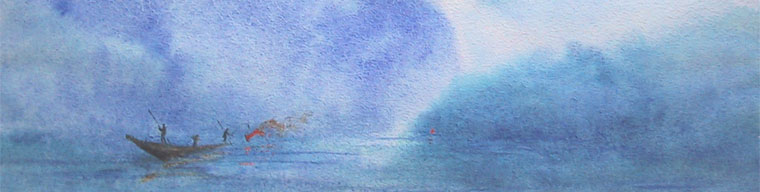
The world we inhabit is intricately connected in ways not immediately apparent. With a bit of imagination, linkages between the world we see with our naked eye and the world we see through a microscope can be discovered. This exhibition of watercolour paintings and SEM (Scanning Electron Microscope) images, conceived by a geographer and biologist at the University of Lethbridge, seeks to illustrate a few of the macro-micro connections of our living planet. We have attempted to establish, in an aesthetic way, functional connections between the natural beauty of landscapes shaped by humans, and the beauty of nature as expressed in the contours of both animate and inanimate forms. Each pair of illustrations is accompanied by brief text that provides background information and highlights the connection between the individual scenes. Some of the comparisons are obvious, while others are subtle, requiring observers to stretch their minds and engage their imagination.
Hiroshi Shimazaki & Doug Bray
New exhibit combines art and science in a new way.
By David Sulz, The Lethbridge Herald, September 30, 2004
At first glance the worlds of art and science would seem to be polar opposites. But a new exhibit opening Saturday at the lethbridge public library gallery blends the two realms in a collection designed to show the linkages between what we see with the naked eye and the world as seen through the microscope.
Living Planet: Macro – Micro Connection matches watercolor paintings by Hiroshi Shimazaki, a professor in the University of lethbridge’s faculty of management, with images captured by the U of L’s scanning electron microscope (SEM).
Shimazaki worked closely with his long time tennis partner Doug Bray, a semi-retired veteran of electron microscopy at the U of L, in planning the exhibit, which features a dozen of water colors and SEM images.
The aim is to show, “in an esthetic way, functional connections between the natural beauty of landscapes shaped by humans and the beauty of nature as expressed in the contours of both animate and inanimate forms,” says the handout the pair prepared for the exhibit.
“The most difficult task was to clarify the connections,” says Shimazaki.
“We went back and forth a few times,” says Bray, noting they started with 20 sets of images before coming up with the final 12.
Some of the connections are, such as the set matching Shimazaki’s painting of a Japanese fishing village with an SEM image of an octopus sucker. Others were more subtle, as is the case in the matching of a painting of windmills at the River Amstel with a magnification of insect hairs.
Shimazaki doesn’t see it as a stretch to merge the interpretive eyes of art and the more exacting view of science in such a way. “The two disciplines are not exclusive.”
Bray has had a long interest in the artistic aspect of microscopy. He took up photography as a teenager and says a photographer’s artistic eye also proves useful when making images with an electron microscope. Shimazaki’s artistic interest has deep roots as well. He has spent more than 30 years recording landscapes with pen and wash, then producing watercolors such as those in Living Planet. Some, he says, require some adjustments for the exhibit.
Shimazaki expects the exhibit will appeal “to the artistic crowd but also the scientific crowd.” Bray feels the unsual mix “could appeal to all ages.”
The two have been tennis partners for some 20 years but the exhibit represented “the first time we have done anything intellectual together,” says Bray. “It was a riot. We’re still having fun with it.” It was too much fun, the two are pondering expanding the idea at a future date.
The exhibit opens Saturday and runs until Nov. 30. The opening reception is scheduled for Oct. 17 from 3-5pm. Examples of Shimazaki’s paintings can be viewed on the web at www.uleth.ca/~shimazaki
|