






Research
Introduction
I use field-, lab-, and theory-based approaches to study a variety of problems in population, community, and evolutionary ecology. Much of my research has concerned plants and their interactions with insects, fungi, and other plants, although recently I have begun to delve into more generic theoretical issues in ecology and evolutionary biology. In the following, I briefly describe some of my recent research projects. For more details, see my Publications page or send me an email (robert.laird at uleth.ca).
Fungus-plant-insect interactions
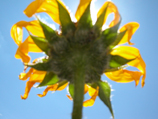
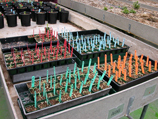
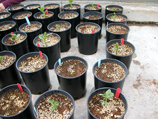
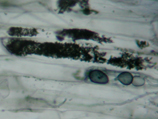
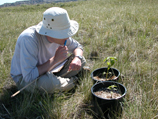
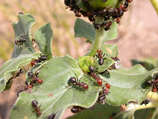
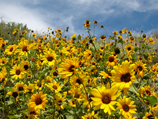
Mycorrhizal fungi form symbioses with the roots of most plants, in most environments, most of the time. These symbioses are typically mutualisms, with both the fungus and the plant benefiting from the relationship - the fungus helps its host plant forage for water and nutrients, and in return, receives carbon that the host plant fixes during photosynthesis. Another ubiquitous set of interactions are those between plants and insects. Plant-insect interactions include herbivory, pollination, seed dispersal, and protection-for-food mutualisms. Because both fungi and insects frequently modify physiological traits of their host plants, there is a strong potential for indirect effects between mycorrhizal fungi and insects. My research on fungus-plant-insect interactions combines field work at Dinosaur Provincial Park and elsewhere, with greenhouse and growth-chamber work, to investigate how mycorrhizal fungi affect herbivory by the leaf beetle, Zygogramma exclamationis, on the common annual sunflower, Helianthus annuus. A related project involves investigating how mycorrhizal fungi affect their host plant's production of extra-floral nectaries (in Broad Bean, Vicia faba), and in turn, how this affects insects (e.g., ants) that use extra-floral nectar as a food source. Many more types of plant-mediated indirect effects are possible, providing exciting new avenues for expanding this line of research.
Non-transitive competition and species coexistence
Species coexistence is one of the central problems in community ecology. How can so many species coexist in the face of intense competition for resources? Most explanations of species coexistence involve the mitigation of competition. With my colleague, Brandon Schamp of Algoma University, I am studying how competition itself can lead to coexistence, provided that some of the competitive interactions are non-transitive, similar to the game Rock-Paper-Scissors. So far, we have used a combination of simulation and analytical models to investigate the details of how non-transitive competition promotes coexistence, and how this is affected by spatially local interactions. We plan to test our models by examining non-transitive competition in plant communities.
Evolution of senescence
Senescence, or aging as it is known colloquially, is characterized at the individual level by a decline in condition and physiological function with increasing chronological age, and at the population level by decreased survivorship and fecundity with increasing chronological age. Senescence is a nearly universal trait across the tree of life, spanning the prokaryotes and eukaryotes. Yet senescence is somewhat of a puzzle for evolutionary biologists, because all else being equal, one might expect individuals that senescence very slowly (or not at all) to be selected for over those that do senescence. Most mainstream evolutionary theories of senescence propose that senescence results from functioning deleterious genes with late-acting effects that remain unpurged in organisms' genomes because there is little selection on old age classes ('mutation accumulation theory') or because such genes have beneficial effects earlier in life ('antagonistic pleiotropy theory'). However, biogerontological findings suggest that the proximate causes of aging are more often damaging agents (e.g., reactive oxygen species), rather than genetic 'time-bombs'. With Tom Sherratt of Carleton University, I am studying a damage-based model of aging, combining reliability theory with evolutionary dynamics. Tom and I are also part of a larger international collaboration (led by Tom) on empirical patterns of senescence in odonates (damselflies and dragonflies).
Evolution of cooperation
My most recent avenue of research concerns the evolution of cooperation. Cooperation is important to many of the major transitions in evolution (genes to genomes, cells to multicellular bodies, individuals to societies, etc.). Yet cooperation is a puzzle in evolutionary biology because cooperators are vulnerable to exploitation by defectors; those who accept the benefits of cooperation yet fail to reciprocate. Most of the proposed mechanisms of cooperation are concerned with how to get cooperators to interact assortatively, i.e., more often then their relative abundance in a population would dictate. I am investigating a number of theoretical issues concerning the evolution of cooperation including the effects of spatially explicit interactions and so-called 'green-beard effects'. This is a fascinating topic, and one that I'm looking forward to studying further!
Other topics...
I tend towards generalism, so I like to work on a variety of topics in ecology and evolution. I am happy to consider supervising students working on tangentially related projects, particularly those involving evolutionary dynamics and/or plant ecology.


