ELEMENTS. CHEMICALS. MINERALS. MOLECULAR. PHYSICAL.
Welcome to the Department of Chemistry & Biochemistry
Chemistry is often called the central science as it deals specifically with the 112 elements that comprise all matter. There are five branches of chemistry: analytical chemistry, organic chemistry, inorganic chemistry, physical chemistry and theoretical chemistry. The primary focus of the program is to provide you with extensive theoretical knowledge in all five branches of chemistry while enhancing your technical and practical skills with hands-on experience and research opportunities.
The Departments of Chemistry & Biochemistry and Biological Sciences jointly offer a multi-disciplinary major in biochemistry for the 40-course Bachelor of Science (BSc). You can also select a general major in the sciences and choose biochemistry courses as options. Biochemistry will help you develop a strong background in the basic sciences and extensive laboratory skills. Thereby, it provides background for a diverse range of careers in the life sciences, including professional programs such as medicine and veterinary medicine.
The Department of Chemistry & Biochemistry is home to many advanced instruments which enable cutting-edge research. These tools include nuclear magnetic resonance (NMR), infra-red, Raman, UVvisible, atomic absorption spectrometers, macromolecular x-ray diffractometer, isothermal titration calorimeter, and a surface plasmon resonance spectrometer.
Apply Now!
Department Highlights
KUDOS
Kudos to Chemistry & Biochemistry PhD student Nathan Hill (BSc '16), whose paper, co-written with Dr. René Boeré, has been accepted for publication in the prestigious Chemistry — A European Journal later this year. During peer review, the paper received a "very important" rating, which happens for less than five percent of the journal's published articles. The paper has also been lauded by an expert in the field of title compounds as "one of the most fundamental contributions to the field of all time!" Find it online: N,N’-Diaryl-Sulfurdiimides are Strongly Redox Tuned
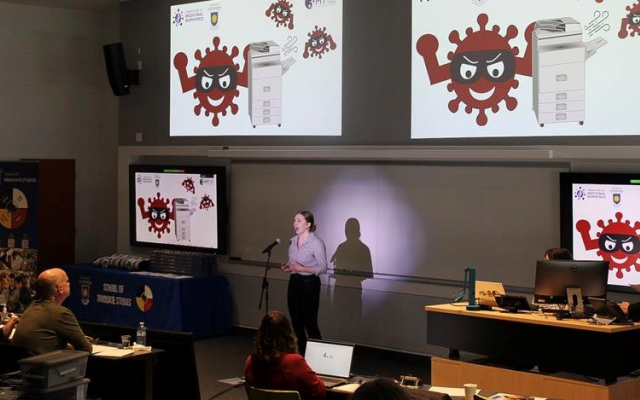
Winners in the 3MT competition
Congratulations to the winners of the 3MT and Images of Research competitions held on Saturday as part of the Meeting of the Minds conference.
Winners in the 3MT competition include the following:
First Place — Jenna Letain | The Buzz About Honey Bee Viruses
Second Place — Emma Neigel | Ecological Football: Making a Conservative Touchdown
Third Place — Jade Oldfield | Enhancing Executive Functions Through Play
People's Choice — Supriya | Colonial Shadows: Addressing Mental Health Disparities Among Asian Immigrants
Jenna Letain's (pictured above) thesis work involves finding out which proteins in honey bees are hijacked by viruses and how that affects their immunity. With significant losses in the population of honey bees and no treatments for these viruses, research is needed to help in the development of therapeutics.
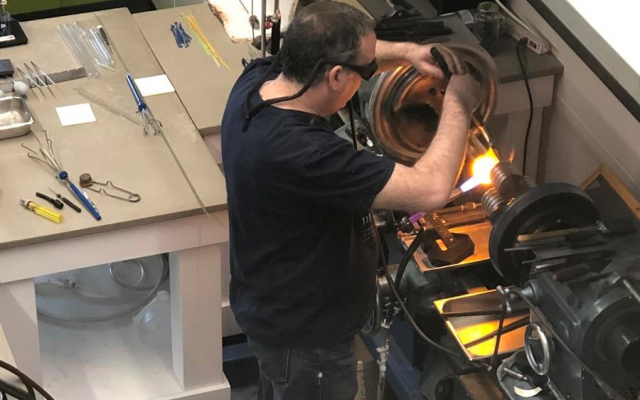
Glass-blowing Station
Photos of the week
Kris Fischer, an instructor in the Department of Chemistry & Biochemistry, uses a graphite paddle to shape a medieval drinking vessel at the glass-blowing station in the Technical Services department. Kris also makes any specialty glass equipment needed to conduct experiments.
Shining Student Uvindu Abeysekara: A journey of academic excellence, research, and community engagement at ULethbridge
With unwavering determination, creativity, and an outgoing nature, Uvindu Abeysekara's ULethbridge journey serves as an inspiration, urging us to seize opportunities and push beyond our comfort zones for a transformative university experience.
From iGEM to innovating antibiotics: Sydnee Calhoun's inspiring journey at ULethbridge
From her early involvement in the iGEM competition to her research in the field of biochemistry, Sydnee Calhoun (MSc '23 (BSc Co-op '19)) has left an indelible mark on the University and …
Shining Student Ty Dudas
Third-year neuroscience student Ty Dudas embraces ULethbridge’s liberal education philosophy and takes courses outside his major. This discovery led him to organic chemistry and research he hopes will be used to make …
Career Bridge: Centre for Work-Integrated Learning and Career Development
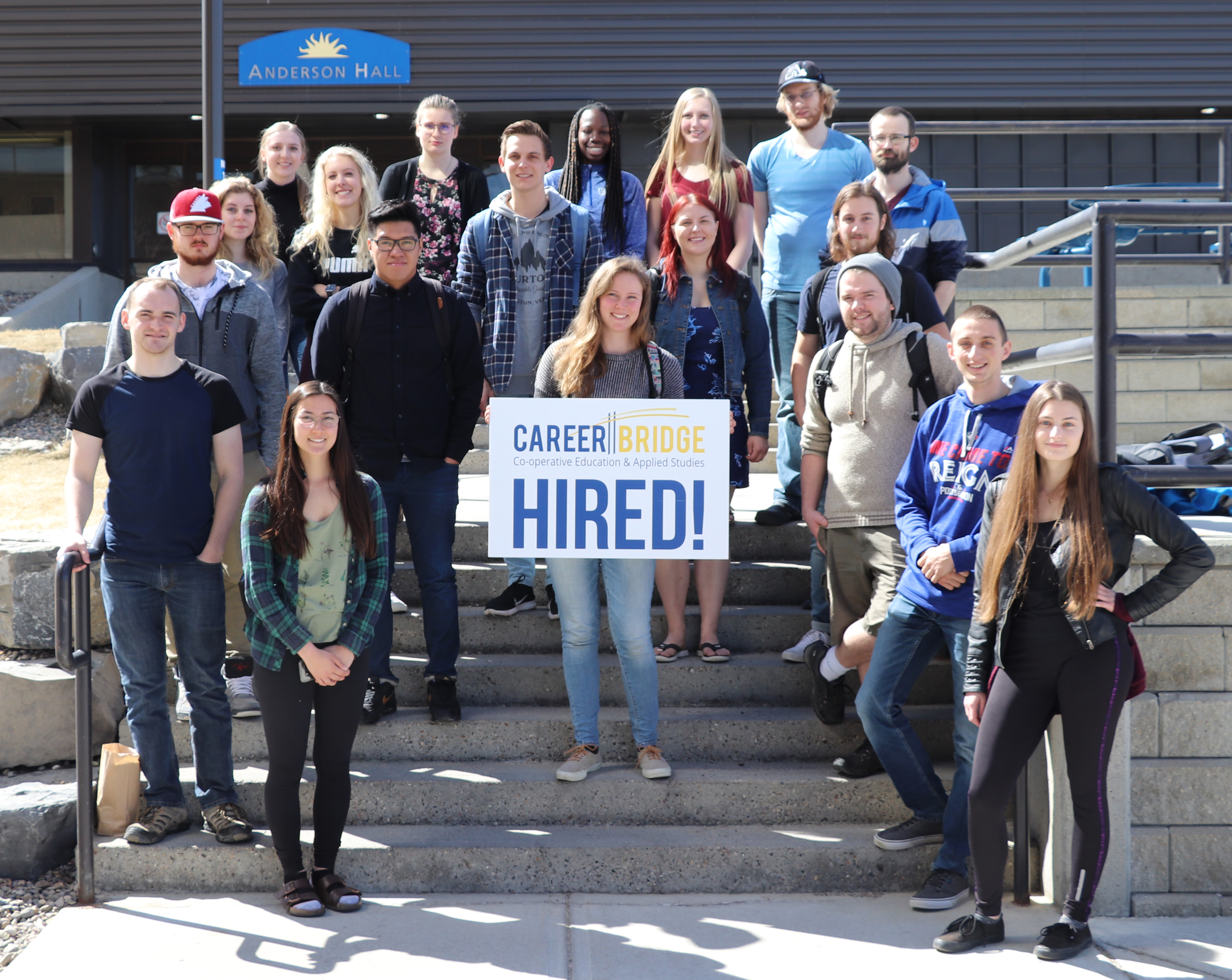
Put Your Knowledge to Work
Whether you’re looking for a more in-depth learning experience by assisting with research projects on campus or by testing your knowledge in a real-life work setting, we can help! The University of Lethbridge is proud to offer you an exceptional opportunity to explore professional development through academic programs and services designed to give you a competitive edge in a fast-changing world.
You have a bright future — experience it via Career Bridge at uLethbridge!